
Host
Suspendisse tristique vehicula ante tortor, ut auctor diam ornare ut. Pellentesque et ex et dolor tempor suscipit. Phasellus vel orci vel orci tincidunt interdum. Nunc quis viverra metus. In cursus tincidunt. Nam consequat nibh justo, non sollicitudin sem placerat vitae.
Client & task
Suspendisse tristique vehicula ante tortor, ut auctor diam ornare ut. Pellentesque et ex et dolor tempor suscipit. Phasellus vel orci vel orci tincidunt interdum. Nunc quis viverra metus. In cursus tincidunt. Nam consequat nibh justo, non sollicitudin sem placerat vitae.
Objectives
Accurate magnetic component design is essential for modern power electronics, especially as converters operate under increasingly dynamic and non-sinusoidal conditions. Traditional frequency-domain loss models, while useful, often fail to capture the nonlinear and time-dependent behaviour of magnetic materials subjected to realistic switching waveforms. Dynamic hysteresis models (DHMs) offer a powerful alternative by enabling time-domain simulation of magnetisation processes and losses, thereby improving predictive accuracy for applications such as LCL filters and boost inductors.
This project builds a comprehensive design workflow that integrates advanced hysteresis modelling, material characterisation, and time-domain simulation tools. Through a combination of experimental measurements, modelling, and practical validation, the work aims to enable accurate, high-efficiency inductor design suitable for industrial converter applications.
Objectives 1
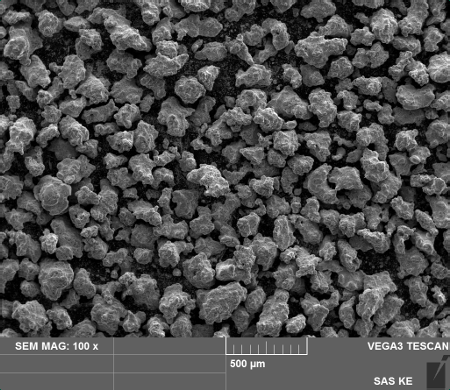
Measurement of magnetisation curves and losses from different materials: laminations, SMCs (from UPJS) and ferrites (from CERTH).
Objectives 2
Identification of phenomenological dynamic hysteresis models (DHMs)67 for the aforementioned materials based on the measurements.
Objectives 3
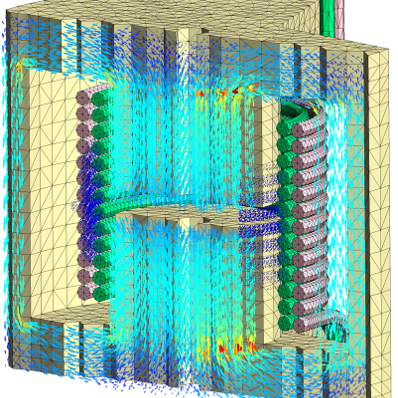
Implementation of the DHMs in MATLAB/Simulink environment. and coupling to Simscape blocks for accounting for converter supply.
Objectives 4
Design and optimisation of single-phase LCL filter inductors using the Simulink tools: Parametrising the inductor with respect to turn number N, cross-sectional area AFe, magnetic path length lFe and air-gap length δ. Finding optimal N, AFe, lFe and δ for a filter inductor and a boost inductor, so that current ripple limits are met and a pareto-optimum for efficiency/power density is found.
Objectives 5
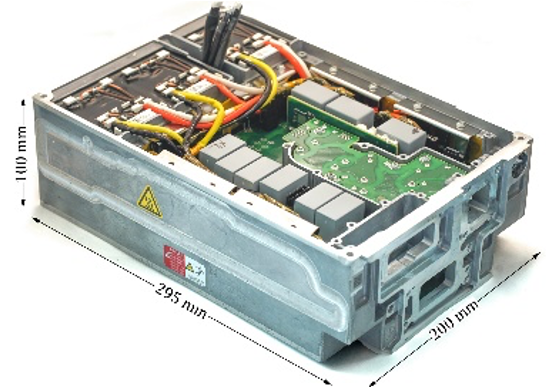
Validation measurements in an industrial converter application.

Expected Results
Lorem ipsum dolor sit amet, consectetur adipiscing elit. Phasellus et massa nec arcu efficitur ultrices. Proin laoreet neque eu ligula pretium, vel congue urna faucibus. Integer ut felis dui. Phasellus tincidunt lacus ac ex laoreet, ac ultricies quam condimentum. Vestibulum ante ipsum primis in est.
67%
Time-domain circuit-simulation tools for magnetic cores including core losses.
67%
New design workflow for single-phase inductors

Sed fringilla gravida lorem, id rhoncus justo egestas sed. Nulla sagittis vel ante sit amet neque non tellus interdum tincidunt eget eu odio. Awesome!