
Work Package Description
The second Research Objective is to establish a cutting-edge multi-physical modelling platform, achieving a drastic improvement in computational efficiency with the development of reduced-order time-domain numerical models and multiharmonic modelling techniques. These electromagnetic and thermal models will be integrated with existing circuit and system simulation tools to enhance both the design and control of magnetic components in HF power electronics for energy conversion. The target is to reduce simulation times by at least 25% while maintaining or improving accuracy. Also, develop new and highly accurate (semi-)analytical models derived from these tools, with an aim to be effectively used in several scenarios, considering various non-linearities such as losses, saturation and hysteresis.
- Easy to use admin panel
- Modern design
- Dedicated tech specialists
- Free 24/7 support
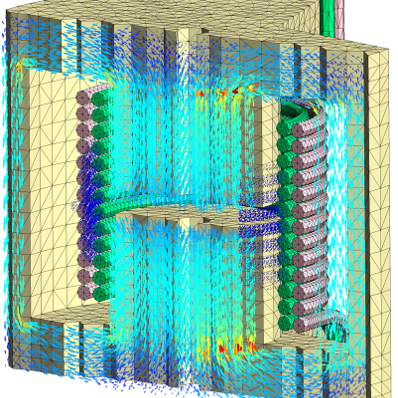
We aim at integrating the multi-physical (thermo-electro-magneto-mechanical) and material models developed by Work Package 1 PhD activity, DC1-3, within the advanced high-fidelity and efficient multiscale computational modelling tools of the magnetic components developed by two Doctoral Candidates, DC4 and DC5, ensuring a highly accurate analysis of the eddy-current and iron loss at the component level. DC2 will describe the connections between the power losses of MnZn ferrites and dimensional resonance effects at high frequencies. DC3 will combine the statistical loss theory with micromagnetic simulations to obtain a more accurate physical description of iron losses in different magnetic materials. From the material level, we move progressively to the component and circuit level. Indeed, DC4 will combine (AI- and/or FE-based) reduced-order modelling techniques with multi-physical numerical homogenisation to achieve computationally efficient HF simulation tools for magnetic components; DC5 will use magnetisation curves and losses from WP1 to implement dynamic hysteresis models suitable for accurate iron loss computation in a circuit environment (MATLAB/Simulink). The HF capacitive effects in the windings of magnetic components will be studied by another PhD Candidate, DC6, to enhance the design of the magnetic components and ensure the reliability of the applications in WP3. PhD Candidate number seven, DC7, will develop harmonic-balance (multi-harmonic) simulation methods in view of the co-simulation of field models and PE circuits, efficiently accounting for disparate time scales with focus on ad-hoc time-domain functions and the harmonic selection. DC4 and DC5 will incorporate the material models in the component level simulation tools in view of an efficient co-simulation approach needed for the resolution of the Research Objective 2: Efficient time-domain and steady-state tools for multi-physical modelling, design, and control. The research of DC5-7 is highly interrelated and application dependent; they will work in parallel and exchange results with WP3, contributing to the efficient time-domain and steady-state modelling tool that is expected to resolve the second Magnify Research Objective.
Research Gaps filled– Robust & efficient time-domain (transient) and frequency-domain (multi-harmonic, steady state) co-simulation of electromagnetic and thermal field models and PE circuit, with a drastic reduction in simulation time and increased accuracy. Multi-scale and multi-physical models: from material through component and circuit to application.