
September 2026 - Issue: #1
We are delighted to welcome you to the first edition of the MAGNIFY newsletter. Over the next four years, this newsletter will keep you up to date with the
progress of the MAGNIFY Marie Skłodowska-Curie Doctoral Network, sharing our latest research developments, training activities, events, project
milestones, and the people behind our success. As we embark on this exciting journey, this inaugural issue introduces the vision of MAGNIFY, our consortium,
and the ambitious research programme that will help shape the future of sustainable power electronics.
- Ruth V. Sabariego KU Leuven– MAGNIFY Project Lead
Why MAGNIFY?
The global transition towards clean and sustainable energy depends on increasingly efficient power electronic systems. From renewable energy and electric mobility to energy storage, data centres and industrial automation, power electronics play a fundamental role in converting and managing electrical energy.
As electrification accelerates, the demand for compact, reliable and high-efficiency energy conversion technologies continues to grow.
At the heart of these systems are magnetic components—such as inductors and transformers—which largely determine the efficiency, power density and reliability of power electronic converters. Despite their critical role, their design remains a major challenge due to the complex interactions between magnetic materials, electromagnetic behaviour, thermal effects and manufacturing constraints.
At the heart of these systems are magnetic components—such as inductors and transformers—which largely determine the efficiency, power density and reliability of power electronic converters. Despite their critical role, their design remains a major challenge due to the complex interactions between magnetic materials, electromagnetic behaviour, thermal effects and manufacturing constraints. MAGNIFY addresses these challenges by bringing together expertise across the entire value chain, from the development of advanced magnetic materials and multiphysics modelling to the design, optimisation and validation of next-generation magnetic components for high-performance power electronic systems.
About the Project
MAGNIFY is a Marie Skłodowska-Curie Doctoral Network, funded by the European Union, that fosters a collaborative and interdisciplinary research environment by bringing together complementary expertise from academia, research organisations and industry.
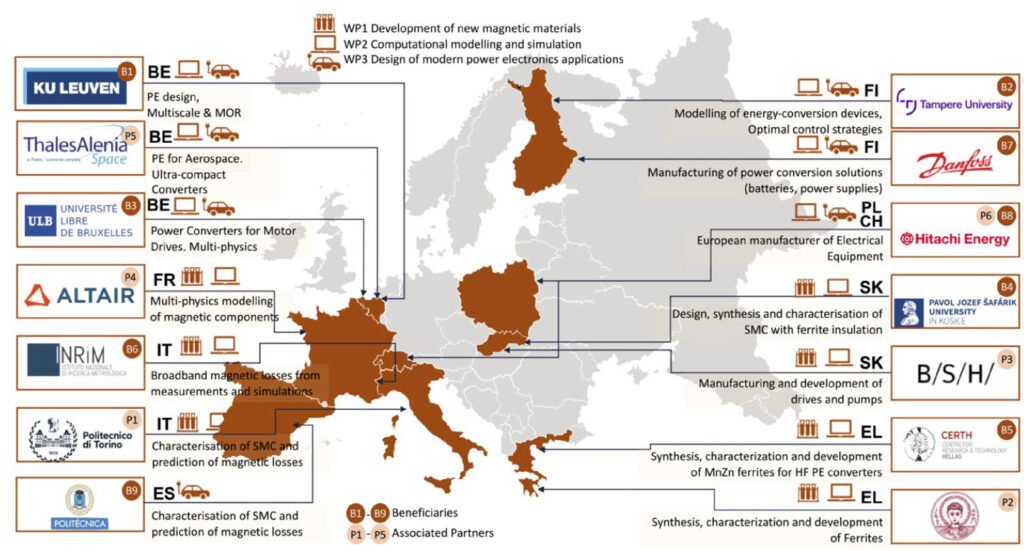
Our consortium comprises leading universities and research centers (KU Leuven, ULB, UPM, INRiM, Politecnico di Torino, Tampere University, Pavol Jozef University, CERTH, AUTh) and industrial partners (Danfoss, Hitachi, B/S/Hm Altair, Thales Alenia) with expertise spanning magnetic materials, electromagnetics, computational modelling, power electronics and advanced manufacturing. This broad knowledge base enables MAGNIFY to address the complete innovation chain, from material development and characterisation to multiphysics modelling, magnetic component design and system-level validation.
This multidisciplinary and intersectoral approach not only accelerates scientific innovation but also provides an outstanding training environment for the 15 Doctoral Candidates, that will become future leaders in sustainable power electronics and energy conversion.
MAGNIFY Objectives
- Advanced materials.
- Experimental characterisation.
- Comply with device requirements.
- Sustainable processes.
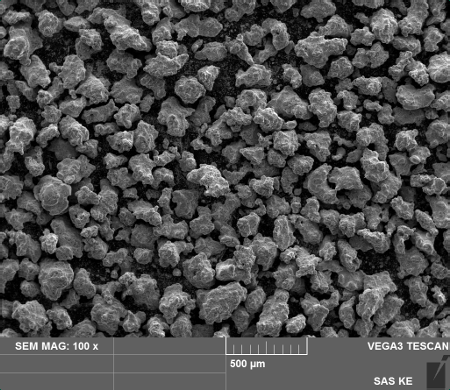
The first step towards more efficient power electronics begins with better magnetic materials. We will develop and characterise innovative soft magnetic composites and ferrite materials specifically designed for high-frequency applications. The project aims to create more sustainable materials with enhanced performance, enabling smaller, more efficient and more reliable magnetic components for future energy conversion systems..
- Bandwidth aware insight on physics interactions.
- Reduced-order models of functional blocks.
- Co-simulation: critical circuit coupling.
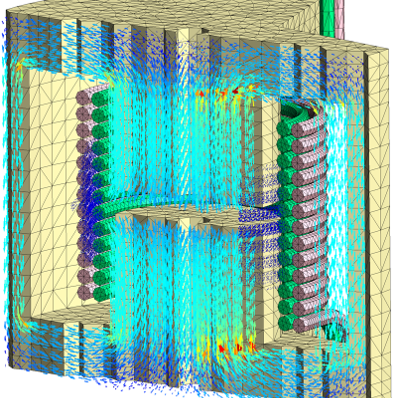
WP2 focuses on developing advanced computational tools for accurate and efficient design of high-frequency magnetic components and power electronic systems. By combining electromagnetic, thermal and mechanical models across multiple scales, from magnetic materials and components to circuits and complete converters, the project will create fast and reliable multiphysics simulation tools. These next-generation models will allow engineers to optimise power electronic systems more efficiently and with greater confidence
- From material to device.
- Model-based design & optimisation.
- Integrated electromagnetic & thermal constraints.
- Electromagnetic compatibility.
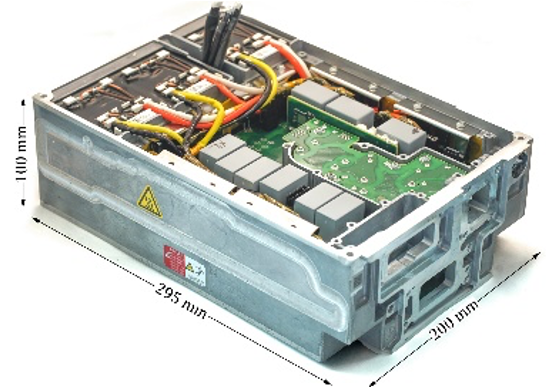
WP3 transforms the innovations developed in the previous work packages into practical engineering solutions. By combining advanced magnetic materials with state-of-the-art computational models, researchers will design, optimise and prototype high-performance inductors, transformers and electromagnetic filters for high-frequency power electronic applications. The resulting prototypes will be validated in industrially relevant applications, paving the way for more sustainable and higher-performance power electronic systems.